

 Translate
 Translate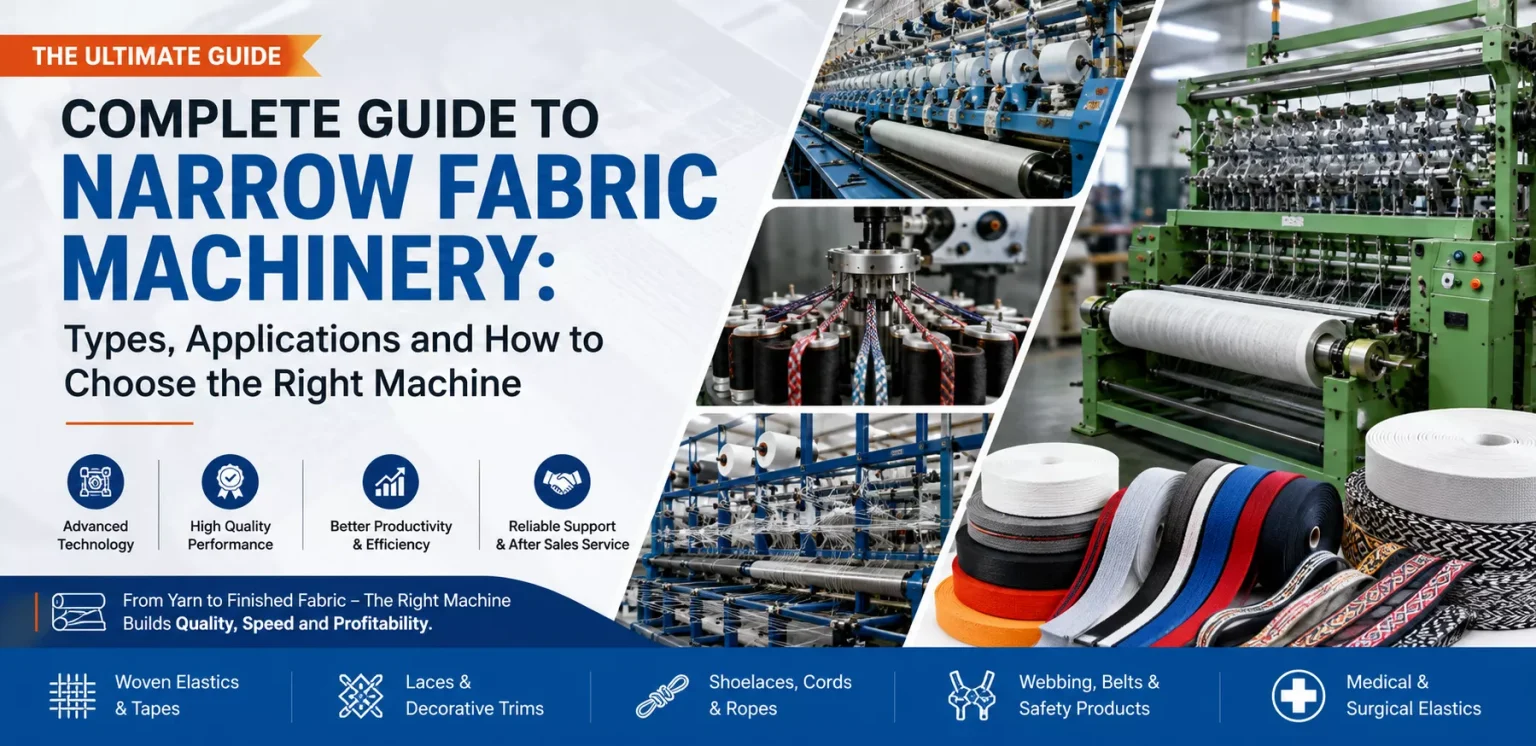
Table of Contents
Complete Guide to Narrow Fabric Machinery: Types, Applications and How to Choose the Right Machine
What is Narrow Fabric?
Narrow fabric is any woven, knitted or braided textile produced in a strip form, typically under 30 centimetres wide, as opposed to the broad sheets of fabric used for garments or upholstery. It’s a category defined by its narrow width rather than its structure — a narrow fabric can be woven, warp-knitted, or braided, and can be elastic or non-elastic.
Despite the modest width, narrow fabric sits behind a surprisingly wide range of everyday and industrial products: the waistband of a pair of trousers, the strap on a bag, the lace on a shoe, the tape sewn into a mattress cover, or the webbing on a safety harness. Because it’s a functional component rather than a finished product in itself, demand for narrow fabric tracks closely with garment manufacturing, home textiles, medical supplies, packaging and industrial safety equipment.
What is Narrow Fabric Machinery?
Narrow fabric machinery refers to the specialised equipment used to produce, prepare and finish these narrow-width textiles. Unlike broad-loom weaving, narrow fabric production uses purpose-built machines — crochet machines, needle looms, braiding machines — each suited to a particular fabric structure, along with supporting equipment for yarn preparation, winding and finishing.
This is a specialised corner of textile engineering. Buyers are rarely choosing between “a machine” and “no machine” — they’re choosing between machine types that each produce a structurally different fabric, which is why understanding the categories below matters more than comparing brochures on price alone.
Main Categories of Machines
Narrow fabric machinery falls into five broad categories, moving from yarn preparation through to the finished roll.
| Category | Fabric Structure | Typical Output |
|---|---|---|
| Crochet machines | Warp-knitted | Elastic, lace, medical tape, decorative trims |
| Needle loom machines | Woven | Webbing, ribbon, woven elastic, garment tape |
| Jacquard needle looms | Patterned weave | Branded tape, labels, decorative jacquard fabric |
| Braiding machines | Braided | Shoelaces, cords, ropes, belts, wire harnesses |
| Warping, winding & finishing | Preparatory / finishing | Beam preparation, package winding, heat-setting |
The sections below cover each category, what it produces, and how to tell if it fits your product.
Crochet Machines
Crochet machines produce warp-knitted narrow fabric — a looped construction that gives the fabric natural stretch, softness and flexibility, even before any rubber or spandex yarn is introduced. This makes crochet machines the standard choice for elastic tape, lace trims, medical and surgical elastic, and soft decorative products.
What they’re good for:
- Knitted elastic for waistbands and garment trims
- Lace and decorative narrow fabric
- Medical and surgical elastic bandages
- Soft, flexible tape that needs to conform to the body
Buyers evaluating crochet machines should look closely at the number of guide bars (which determines pattern range), needle gauge, and working width, since these three specifications together define what products the machine can actually produce.
Needle Loom Machines
Needle looms weave narrow fabric using a needle-and-hook shedding mechanism rather than a shuttle, which makes them faster and better suited to narrow widths than conventional shuttle looms. The woven construction produces a firmer, more dimensionally stable fabric than crochet knitting — the reason needle looms dominate webbing, ribbon and structural tape production.
What they’re good for:
- Woven elastic and non-elastic tape
- Webbing for bags, belts and safety equipment
- Ribbon and garment trims
- Applications needing a firmer, more stable fabric hand
Needle looms are typically specified by number of weaving heads, frame count and whether they run elastic, non-elastic, or both — a distinction worth confirming early, since it directly affects yarn feed and take-up configuration.
Jacquard Needle Looms
A jacquard needle loom is a needle loom fitted with a jacquard patterning head, allowing individual warp yarns to be controlled electronically rather than by a fixed mechanical pattern. This makes it possible to weave logos, text, and complex multi-colour designs directly into the tape — the technology behind branded labels, woven name tapes, and decorative jacquard ribbon.
Buyers who need custom branding, changing patterns across short runs, or fine multi-colour detail should look at jacquard needle looms over a standard needle loom, since the electronic pattern control removes the mechanical-cam changeover that standard looms require between designs.
Braiding Machines
Braiding machines interlace multiple yarn carriers around a moving axis to form a braided rope, cord or flat braid — a structure that’s notably strong along its length and resistant to unravelling at a cut end, which is why it’s the standard construction for shoelaces, drawcords, ropes and wire-harness sleeving.
- Round braid: Cord & shoelace braiding — produces round cords, shoelaces and drawstrings. Carrier count determines cord diameter and density.
- Flat/wide braid: Belt & webbing braiding — produces flat braided belts and industrial webbing where higher tensile strength is required.
- Rope: Solid & spiral rope — heavier-gauge braiding for industrial rope, lifting slings and FIBC lifting belts.
- Harness: Wire harness sleeving — fine-gauge braiding used to sleeve and protect electrical and automotive wire harnesses.
Warping and Preparatory Machinery
Before any yarn reaches a crochet machine, needle loom or braiding machine, it has to be wound onto beams or bobbins in a controlled, even tension — that’s the job of warping machines and preparatory equipment. Poor warping is one of the most common root causes of uneven fabric, tension marks and yarn breakage downstream, which is why this category matters more than buyers often expect.
Warping machinery includes beam warpers for needle looms and jacquard looms, and bobbin-winding creels that feed crochet and braiding machines. Getting this stage right protects the output quality of every machine downstream of it.
Finishing and Winding Machinery
Finishing and winding equipment turns raw fabric off the machine into a saleable, packable product. This includes festooning machines (which fold fabric into stacked lengths for dyeing or heat-setting), heat-setting ovens for elastic tape, and winding machines that roll finished tape onto cones, spools or rolls ready for dispatch.
For elastic products specifically, heat-setting is not optional — it stabilises the stretch recovery of the fabric so it doesn’t lose elasticity after a few wash cycles, which is a quality point worth confirming with any machinery supplier.
What Each Machine Manufactures
| Machine | Finished Products |
|---|---|
| Crochet machine | Knitted elastic, lace, medical/surgical elastic, mattress tape |
| Needle loom | Woven elastic, webbing, ribbon, garment tape |
| Jacquard needle loom | Branded labels, name tapes, decorative jacquard ribbon |
| Round braiding machine | Shoelaces, cords, drawstrings |
| Flat/wide braiding machine | Braided belts, industrial webbing |
| Rope braiding machine | Industrial rope, FIBC lifting belts |
How to Select the Right Machine
Machine selection should start from the finished product, not the machine catalogue. Work backward from what you intend to manufacture, then narrow down by the factors below.
Selection checklist:
- Confirm the fabric structure your product needs — knitted (crochet), woven (needle loom), or braided
- Define the required tape or cord width and whether it needs to be elastic
- Decide if pattern or branding capability (jacquard) is required
- Set a realistic monthly production target in metres or kilograms
- Check available factory floor space and power supply against machine specifications
- Confirm operator skill level available versus what the machine requires
- Ask about spare-parts availability and after-sales support before ordering
A useful rule of thumb: if the fabric needs to stretch and feel soft against skin, start with crochet machines. If it needs to hold its shape under load, start with needle looms. If it needs to be round, flat-braided, or resistant to fraying at a cut end, start with braiding machines.
Factors Affecting Production Capacity
Two machines with identical model numbers can produce very different daily output depending on a handful of variables that buyers should ask about directly rather than assume from a brochure figure.
- Machine speed (RPM): higher-speed models increase output but can also increase yarn breakage on lower-quality yarn
- Number of heads or carriers: more working positions means more simultaneous output, at the cost of floor space and power draw
- Yarn quality and consistency: inconsistent yarn tension is one of the most common causes of unplanned downtime
- Pattern complexity: jacquard and multi-colour patterns run slower than plain constructions
- Operator experience: changeover time between styles varies significantly with operator skill
- Preventive maintenance discipline: unplanned stoppages, not machine speed, are the biggest hidden cost in most factories
Installation and Maintenance Requirements
Narrow fabric machinery needs a level, vibration-controlled floor, stable power supply matched to the machine’s electrical specification, and adequate clearance for operator access and yarn creels. Most suppliers, including Taha Impex, provide on-site installation and commissioning support, since correct initial setup has a direct effect on fabric quality and machine lifespan.
Ongoing maintenance is largely preventive: routine lubrication, needle and guide inspection, tension calibration, and scheduled replacement of high-wear components such as needles, chain links and guide blocks before they cause quality defects rather than after.
Frequently Asked Questions
A needle loom weaves fabric, producing a firmer, more structurally stable tape suited to webbing and belts. A crochet machine warp-knits fabric, producing a softer, more elastic tape suited to garment elastic and lace.
Both crochet machines and needle looms can produce elastic tape. Crochet machines produce knitted elastic with a softer hand, commonly used in garments and medical products. Needle looms produce woven elastic with a firmer structure, commonly used in industrial and heavier-duty applications.
Working width varies by model, but narrow fabric machines typically produce tape from a few millimetres up to around 300mm, with multiple narrower tapes often run simultaneously across a wider machine bed.
A standard needle loom is sufficient for plain or simple-pattern woven tape. A jacquard needle loom is needed if you require branded logos, text, or multi-colour designs woven directly into the fabric.
This depends on the machine type and number of working heads. Needle looms and crochet machines generally need a compact, level footprint plus creel space for yarn supply; exact dimensions should be confirmed against the specific model's data sheet.
Look for installation and commissioning support, spare-parts availability, and a technical team that can troubleshoot production issues remotely or on-site — not just machine delivery.
Request a Machine Recommendation
Choosing between crochet machines, needle looms, jacquard looms and braiding machines is easier with a specific product and target output in mind. Taha Impex’s technical team can review your requirement and recommend a machine configuration based on the fabric, width and volume you need to produce.
Not sure which machine fits your product?
Send us your target fabric, width and monthly volume — our team will recommend the right machine.